Five exercises, about twelve minutes, most days of the week. That is the whole program.
I have written it the way I prescribe it in clinic, with actual sets and reps rather than "do some chin tucks", because the dose decides whether this works. The research on forward head posture uses roughly three sessions a week over six weeks to produce measurable change. Most people who tell me exercises did not work for them were doing two sets a fortnight.
Every movement below has a video. Watch it once before you start.
Before you start: one check
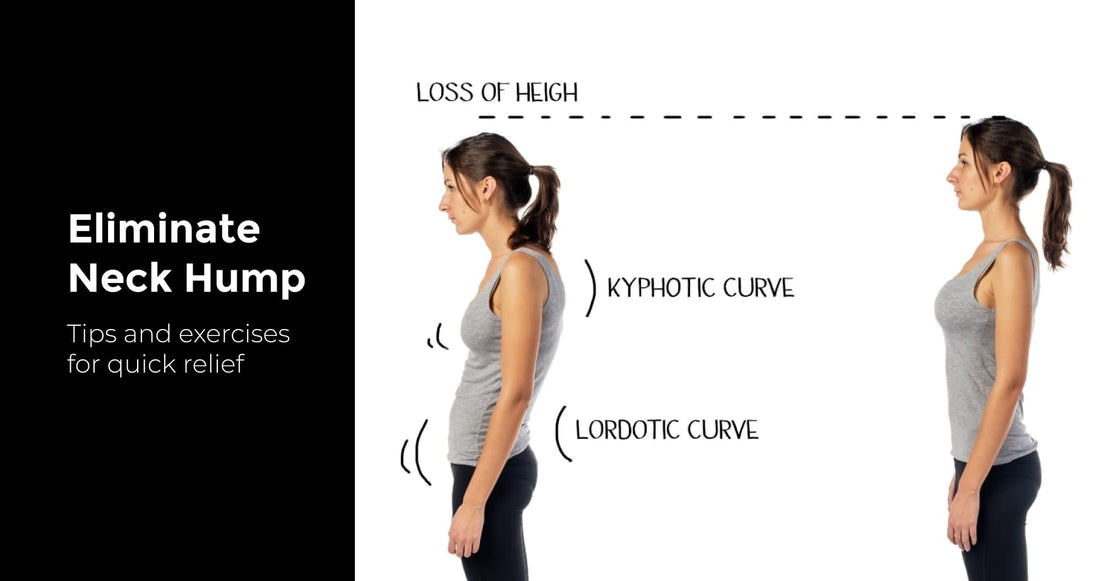
Stand side-on to a mirror. Draw your chin gently back and lift through your breastbone. Watch the hump.
If it visibly flattens, the shape is largely muscular and postural, and everything below applies to you.
If it barely moves, or if the hump is soft and you can pinch it, stop here and read the diagnostic guide first. A soft dorsocervical fat pad and a structural change in the vertebrae both produce the same silhouette, and neither responds to this program. You would be eight weeks in before finding out.
1. Chin tuck, seated or against a wall
The single most important exercise here. It trains the deep neck flexors, the muscles that hold your head over your shoulders rather than in front of them.
Sit or stand tall. Without tilting your chin down, draw your head straight back, as if making a double chin. You should feel a stretch at the base of the skull and a working sensation low at the front of your throat. Hold five seconds. Release.
Ten repetitions, three sets, daily.
The mistake nearly everyone makes is nodding. If your chin drops towards your chest you have swapped to the wrong muscles. Keep your eyes level the whole time.
To progress it, do the same movement standing with your back and head against a wall, heels about 10 cm out, and press the back of your head into the wall on each repetition. If you cannot reach the wall without tilting, put a folded towel behind your head and work towards removing it over the weeks. Losing a towel fold is the clearest measure of progress you will get.
2. Wall extension
Trains the lower trapezius and the muscles that hold your shoulder blades down and back. This is usually the weakest link in the chain.
Stand with your back against a wall, arms up in a goalpost position, backs of the hands and elbows touching the wall. Slide your arms up overhead while keeping the contact, then back down. Move slowly.
Ten repetitions, two sets, four days a week.
Do not let your lower back arch off the wall to buy range. If your hands lift away as they go up, that is your current limit, and it is the thing that improves.
3. Cat-cow
Mobilises the stiff mid-back that forces your head forward in the first place. Strength work into a spine that will not move is wasted effort, so this comes before the strengthening on any given day.
On hands and knees, breathe out and round your upper back towards the ceiling, then breathe in and drop the breastbone towards the floor while lifting the sternum forwards. Move through the mid-back, not the lower back.
Ten slow cycles, two rounds, daily.
4. Shoulder blade squeeze
The direct antidote to a day spent reaching forward at a desk.
Sit or stand tall, arms relaxed. Draw both shoulder blades towards your spine and slightly down, as if tucking them into your back pockets. Hold five seconds without shrugging. Release fully between repetitions.
Twelve repetitions, three sets, four days a week.
If your shoulders climb towards your ears, you are using the upper trapezius, which is already doing too much. Think down and back, not up and back.
5. Chest stretch with neck extension
Opens the front of the chest, which has usually shortened to match the rounded position.
Stand in a doorway, forearm flat on the frame, elbow at shoulder height. Step forward with the same-side foot and rotate your chest away. Hold 30 seconds each side. Then repeat with the elbow higher, around ear height, to catch the upper fibres.
Two positions, 30 seconds each side, daily.
Adding load, and the two exercises to avoid
From about week four, the five above stop being hard enough on their own. Adding resistance is what makes the change hold rather than fade the moment you stop.
Do rows. A band anchored at chest height, or a single-arm dumbbell row with one knee on a bench. Pull with the elbow leading and squeeze the shoulder blade towards your spine at the end. Control the return so it takes twice as long as the pull. Ten to twelve repetitions, three sets, three days a week. This is the one exercise that should feel hard by the last two repetitions. Light bands used casually build nothing. Load matters more than whether you chose bands or dumbbells.
Do not do shrugs or upright rows. Both turn up constantly in neck hump routines online and both are the wrong choice here. They load the upper trapezius, the muscle that is already short, overactive and doing the work your mid-back should be doing. Training it harder reinforces the pattern you are trying to change. Upright rows also carry a real impingement risk at the shoulder. If a routine you find elsewhere leads with shrugs, that is a reliable sign nobody clinical wrote it.
The 8-week schedule
| Mon | Tue | Wed | Thu | Fri | Sat | Sun | |
|---|---|---|---|---|---|---|---|
| Chin tuck | ✓ | ✓ | ✓ | ✓ | ✓ | ✓ | ✓ |
| Cat-cow | ✓ | ✓ | ✓ | ✓ | ✓ | ✓ | ✓ |
| Chest stretch | ✓ | ✓ | ✓ | ✓ | ✓ | ✓ | ✓ |
| Wall extension | ✓ | ✓ | ✓ | ✓ | |||
| Blade squeeze | ✓ | ✓ | ✓ | ✓ | |||
| Rows (from wk 4) | ✓ | ✓ | ✓ |
Full days run about twelve minutes. Light days run about five.
Weeks 1 to 2. Expect soreness at the base of your skull and between the shoulder blades. That is the right soreness. Do not chase range.

From Abanoub, the physio who wrote this program
Flex Neck Stretcher · 4.9★ from 47 reviews
Most people quit this program in the first fortnight because their neck aches. Five minutes of supported traction eases that ache. It will not change the hump's shape. The exercises above do that.
"Very effective and great for relieving neck pain." Teri S., verified buyer
Free shipping · 30-day money back
Weeks 3 to 4. Take a towel fold away on the wall chin tuck. Add the rows.
Weeks 5 to 8. This is where the postural change consolidates. It is also where most people quit, because the fast improvements have already happened and the visible ones have not started. Keep going.
How to tell it is working
Take a side-on photo in your normal standing posture on day one, then at week four and week eight. Same spot, same lighting, same clothing, arms relaxed. Do not stand up straight for the photo. The point is to capture your habitual posture, and a corrected photo tells you nothing.
Three markers, in the order they change:
- Neck and shoulder ache reduces. Usually week one or two.
- You catch yourself in the corrected position without trying. Usually week four to six. This is the real one.
- The silhouette changes in the photo. Week eight at the earliest, more often three to six months.
If nothing at all has shifted by week eight, the assumption about what kind of hump you have was probably wrong. Get it looked at rather than repeating the block.
Where a massage gun fits

Straight answer, and I sell these, so weigh it accordingly. Percussive therapy does not change the shape of your upper back. It has no effect on the angle of your thoracic spine, and I have not seen evidence that says otherwise.
What it does do is reduce tension through the upper trapezius and levator scapulae, the muscles that are tight and sore because they have been holding your head up in front of your body all day. That matters for one practical reason: in the first fortnight, soreness is the main thing that stops people finishing the eight weeks.
Use it for 60 to 90 seconds each side across the upper traps before your exercises, not after and not instead. Keep it off the bony ridge itself, and off the front and sides of the neck entirely.
The Flexgun mini is the one I use for this because the head is small enough to work around the shoulder blade properly. I have written the routine up on its own page, with who it suits and who should not use it: how to use a massage gun on your neck and shoulders. The Flex Neck Stretcher covers the same job on the mobility side if you would rather not use percussion at all. Neither is required. The five exercises are the treatment.
Common questions
How long until I see a difference?
Ache reduces in one to two weeks. Habitual posture changes at four to six weeks. Visible shape change starts around eight weeks and continues for months.
Can I do these if my neck already hurts?
Yes, if the pain is a familiar dull ache. Stop and get assessed if you have pins and needles, numbness or weakness in an arm, or pain that wakes you at night.
Do posture correctors work instead?
Not on their own. In the trial evidence, brace plus exercise substantially outperformed brace alone. A corrector is a reminder. It builds nothing.
Can I do this without any equipment?
Yes. Four of the five need nothing but a wall, a doorway and the floor. For rows, a heavy backpack or a loaded shopping bag works until you get a band.
Are dumbbells better than bands?
Neither is better. Load is what matters. Whichever one you will actually make hard enough is the right choice.
Should I stretch my neck as well?
Gently, on the levator scapulae, and not aggressively. Most neck humps involve muscles at the back that are already long and overworked. Stretching them harder is the most common self-treatment mistake I see.
This article is general information, not personal medical advice. If your symptoms are new, severe or not improving, see a physiotherapist or your GP.
Sources
- Effect of therapeutic exercise on the management of hyperkyphosis in adolescence and young adulthood, a systematic review of nine randomised trials, 2025
- A comparison of two forward head posture corrective approaches in elderly with chronic non-specific neck pain, randomised controlled study
- The efficiency of corrective exercise interventions on thoracic hyper-kyphosis angle